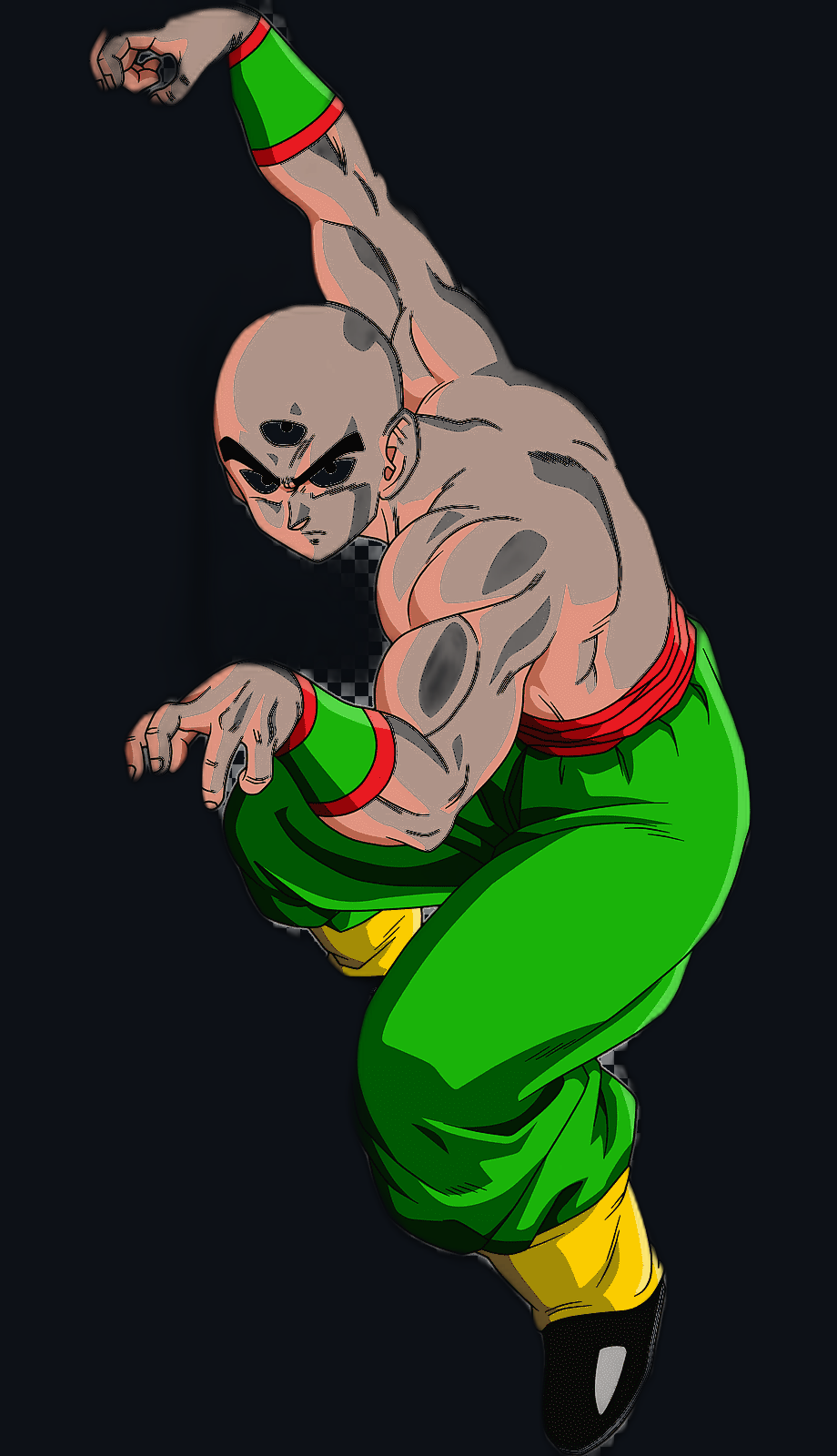
1. Overview and History
The Multi-Form Technique, known in Japanese as the Tajuu Kage Bunshin no Jutsu or simply the Multi-Form, is one of the most distinctive supplementary techniques in the Dragon Ball universe. Created and primarily used by Tien Shinhan, this technique allows the user to split their body into multiple identical copies, each possessing a fraction of the original's total power. The technique was developed as part of the Crane School's martial arts curriculum.
Tien first demonstrated the Multi-Form Technique during the 22nd World Martial Arts Tournament in the original Dragon Ball series. He used it to confound opponents with multiple copies of himself, showcasing the Crane School's emphasis on unorthodox techniques that complemented traditional martial arts. The technique served as a demonstration of Tien's exceptional ki control and his mastery over his own body's energy distribution.
Throughout the Dragon Ball Z series, the Multi-Form Technique appeared sporadically in major battles. Tien employed it against King Piccolo's forces, during the Saiyan invasion, and notably against the Cell Juniors during the Cell Games. Each use demonstrated the technique's continued relevance even as power levels escalated dramatically, proving that utility techniques retain their value regardless of the overall power scale.
For a complete historical account of Tien's techniques and their development, visit the Tien Shinhan page on Dragon Ball Wiki. To explore more about the Crane School's fighting style, check the Crane School entry.
2. Mechanics and Execution
The Multi-Form Technique operates by dividing the user's ki and physical presence into multiple independent bodies. The user concentrates their energy and visualizes multiple versions of themselves, then projects these versions outward into separate, fully formed bodies. Each clone is an exact physical duplicate of the original, complete with clothing and any equipment the user was carrying at the time of division.
The critical mechanical limitation of the technique is the equal distribution of power. If the user creates three copies, each copy possesses one-third of the user's total power. This proportional division means that while multiple bodies provide tactical advantages in numbers, each individual copy is significantly weaker than the single original. This trade-off between quantity and quality is the fundamental strategic consideration when using the technique.
The copies share a single consciousness, allowing for perfect coordination without the need for communication. Each copy acts as an extension of the user's will, enabling synchronized attacks and complex tactical maneuvers that would be impossible with independent allies. However, this shared consciousness also means that the user experiences the sensations and damage from all copies simultaneously, creating a significant mental burden during combat. If one copy is destroyed, the user feels the impact and must redistribute their ki among the remaining copies.
3. Types and Classifications
The standard Multi-Form Technique allows the user to divide into up to four copies. This four-way split is the maximum demonstrated by Tien in the series and represents the practical limit for maintaining effective individual copy strength. Beyond four copies, each duplicate would be too weak to contribute meaningfully in combat, creating a practical ceiling on the technique's numerical advantage.
Tien has also demonstrated a two-way split version of the technique, which sacrifices less individual power while still providing tactical advantages. This variant is useful when the user needs a single distraction or flanking partner without dramatically reducing their combat effectiveness. The two-way split offers the best balance between numerical advantage and individual capability.
An advanced application involves maintaining the split while performing other techniques. Tien has demonstrated the ability to use the Tri-Beam while in Multi-Form, with each copy contributing energy to a single, more powerful blast. This combination technique, sometimes called the Multi-Form Tri-Beam, represents the pinnacle of Multi-Form mastery, allowing the user to amplify their most powerful attacks through coordinated clone energy sharing.
4. Notable Users and Examples
Tien Shinhan is the primary and most skilled user of the Multi-Form Technique. His mastery of the technique sets him apart from other martial artists who have attempted it. Tien's extensive training at the Crane School, combined with his natural talent for ki manipulation, allows him to maintain the technique longer and with greater stability than other practitioners.
Chiaotzu, Tien's closest ally and fellow Crane School student, has also demonstrated the ability to use the Multi-Form Technique. However, his copies lack the stability and combat effectiveness of Tien's, reflecting his lower power level and less refined ki control. The technique has been featured in numerous Dragon Ball video games, where it often appears as Tien's special technique for creating tactical advantages.
Several other characters have attempted similar duplication techniques throughout the series, though none have matched Tien's proficiency. Cell, having absorbed Tien's genetic material, demonstrated a version of the Multi-Form Technique during the Cell Games. The technique's appearance across different characters and eras of the series speaks to its fundamental utility as a combat tool, even if its power division limitation prevents it from being a game-changing ability at the highest levels of combat.
5. Strategic Analysis
The Multi-Form Technique's primary strategic value lies in information gathering and tactical deception. By creating multiple copies, the user can force opponents to divide their attention and energy, creating openings for coordinated attacks. In tournament settings, the technique can confuse opponents who are unfamiliar with its mechanics, as they must determine which copy to engage.
Against single powerful opponents, the Multi-Form Technique can be used to execute complex attack patterns that would be impossible for a single fighter. Multiple copies can attack from different angles simultaneously, creating attack vectors that cannot all be defended at once. This tactic was employed effectively by Tien against opponents who relied on brute force rather than tactical sophistication.
However, the technique's power division creates significant strategic vulnerabilities. Opponents with sufficient power can defeat each copy individually, progressively reducing the user's available forces. The technique also leaves the user vulnerable to area-of-effect attacks that can damage multiple copies simultaneously. Smart opponents can exploit the power division by focusing all their attacks on a single copy, eliminating it and forcing the user to recalculate their strategy and redistribute their remaining energy.
6. Training and Mastery
Mastering the Multi-Form Technique requires exceptional ki control and a deep understanding of one's own energy distribution. The foundational skill is the ability to perceive and manipulate the flow of ki throughout the body, which allows the user to divide their energy evenly among multiple copies. Tien's training at the Crane School provided this foundation through rigorous meditation and ki manipulation exercises.
The next stage of training involves learning to maintain multiple simultaneous perspectives. Since all copies share the user's consciousness, the practitioner must develop the mental capacity to process sensory input from multiple bodies simultaneously without becoming overwhelmed. This cognitive training is often cited as the most challenging aspect of mastering the technique, requiring years of practice to develop the necessary mental discipline.
Advanced training focuses on combat coordination between copies. Practitioners learn to execute complex tactical maneuvers, feints, and combination attacks that leverage the multiple-body advantage. Tien's training included sparring sessions where he faced opponents while in Multi-Form, learning to coordinate his copies' movements fluidly and adapt to changing combat situations in real-time. This level of mastery allows the user to effectively act as a coordinated team of multiple fighters despite being a single individual.
7. Comparisons with Other Techniques
The Multi-Form Technique is often compared to the Super Ghost Kamikaze Attack used by Gotenks, as both techniques involve creating multiple combat entities. However, the underlying mechanics are fundamentally different. Multi-Form divides the user's existing power among copies, while the Super Ghost Kamikaze Attack creates independent energy constructs that explode on contact. The ghost duplicates do not share the user's consciousness and operate as independent combat units.
Compared to fusion techniques like the Fusion Dance or Potara Fusion, the Multi-Form Technique operates in the opposite direction. Fusion combines two fighters into one more powerful entity, while Multi-Form divides one fighter into multiple weaker entities. Both approaches offer strategic advantages in different situations. Fusion is preferred for power-focused combat, while Multi-Form excels in tactical and information-gathering scenarios.
In video game adaptations, the Multi-Form Technique is typically classified as a support or utility technique rather than a direct damage-dealing attack. Games like the Budokai Tenkaichi series treat it as a tactical tool that can create distractions or set up combination attacks. This classification reflects the technique's primary role in the series as a utility tool rather than a finishing move, with its greatest value coming from the tactical options it creates rather than direct damage output.
8. Frequently Asked Questions
Can the Multi-Form Technique be used while transformed?
Yes, the Multi-Form Technique can be used while in transformed states. Tien has demonstrated the technique while using enhanced ki states, and video game adaptations often allow transformed versions of characters to use the technique. Each copy maintains the user's current transformation state.
What happens if one copy is destroyed?
When a copy is destroyed, the user feels the impact and must redistribute their ki among the remaining copies. The destroyed copy's energy returns to the original, slightly strengthening the remaining copies. If all copies are destroyed, the user reforms from the last surviving copy.
Why did Tien stop using Multi-Form in later sagas?
Tien continued to use the technique in later sagas, but the escalating power levels made it less practical against top-tier opponents whose individual power far exceeded Tien's even undivided capabilities. The technique remained useful against evenly matched opponents but was less effective against god-level fighters.
Can the copies use energy attacks?
Yes, each copy can independently perform energy attacks. This was demonstrated during the Cell Games when Tien's copies used the Tri-Beam technique simultaneously. Each copy has independent ki reserves proportional to their share of the user's total power.
Is the Multi-Form Technique the same as illusion techniques?
No, the Multi-Form Technique creates real, physical copies that can interact with the environment and be damaged. This distinguishes it from illusion techniques that create non-physical images. Each copy has solid mass and can be independently targeted in combat.