Overview
The Buu Saga is the final story arc of Dragon Ball Z, adapting the last chapters of Akira Toriyama's manga. This saga follows the awakening of Majin Buu, an ancient magical being sealed away by the Supreme Kais millions of years before. The Buu Saga is the longest and most complex arc in Dragon Ball Z, featuring multiple villain transformations, the introduction of fusion techniques, and the complete destruction and restoration of Earth. The saga also marks Vegeta's definitive turn to good, Goku's debut of Super Saiyan 3, and the final defeat of an ancient evil through the collective energy of all humanity. The tonal shift from the high-tech Cell Saga to the magical Buu Saga represents Toriyama's desire to move away from sci-fi toward fantasy elements.
The Buu Saga reintroduces the concept of magic into Dragon Ball, with Babidi's dark magic, Buu's reality-warping abilities, and the mystical Potara Earrings. The saga explores themes of redemption, legacy, and the meaning of strength. Vegeta's character arc culminates in his sacrifice and confession, while Goku finally takes his place as Earth's distant protector. The saga also introduces the next generation of fighters including Goten and Trunks, who master Super Saiyan at ages 7 and 8, highlighting how the Saiyan race continues to grow more powerful with each generation.
Key Events & Structure
The Buu Saga unfolds in six major phases: the World Tournament setup, Babidi's awakening of Buu, Fat Buu's rampage, Super Buu's evolution, the fusion battles, and the Kid Buu finale. The saga begins at the 25th World Martial Arts Tournament, where Goku briefly reveals Super Saiyan 2 to an Earth audience before being called to fight Babidi's minions. The Supreme Kai's arrival introduces the cosmic hierarchy of the Kais, beings who create planets and oversee the universe's development. Vegeta's deliberate corruption by Babidi's dark magic to match Goku's power creates one of the series' best rival fights.
Fat Buu's initial form is deceptively childlike, but his tantrum-induced destruction builds toward darker transformations. His ability to turn enemies into candy and eat them demonstrates the unique magical threat Buu represents. The absorption concept evolves from Cell's mechanical absorption to Buu's organic assimilation through his body's pink membrane. Super Buu emerges after expelling his evil, creating an even more dangerous form. The fusion sequences featuring Gotenks and Piccolo provide comic relief while Buu absorbs every major fighter. Vegito's appearance via Potara Earrings demonstrates the ultimate fusion power. The saga concludes with Kid Buu's rampage across the galaxy, the desperate Spirit Bomb gathering, and Buu's reincarnation as the goodhearted Uub.
Major Characters & Factions
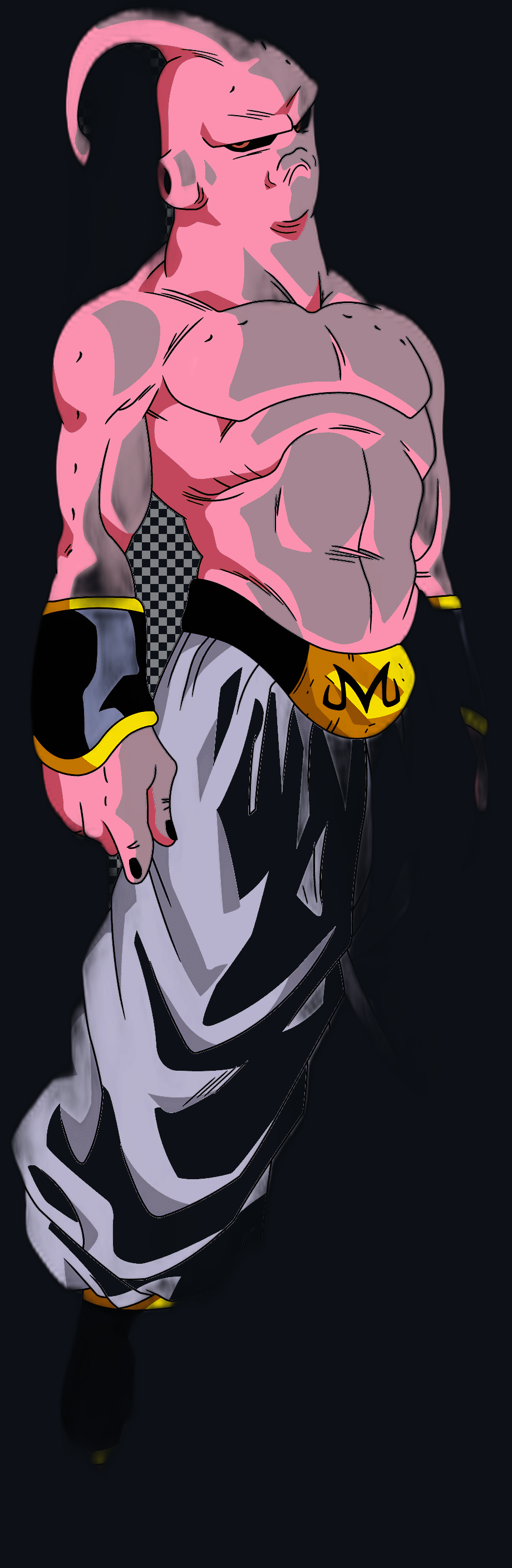
Majin Buu exists in seven distinct forms, each with unique abilities. Fat Buu is innocent but temperamental, capable of immense destruction when angered. Evil Buu emerges from Fat Buu's expelled darkness, tricking his good half into absorption. Super Buu combines power with cunning, absorbing opponents to steal their abilities. Buutenks and Buuhan demonstrate the fusion-absorption mechanic stacking power exponentially. Kid Buu is the original pure form, a chaotic force of destruction with no reason or mercy. Mr. Satan's relationship with Buu provides the saga's emotional foundation, as his friendship with Fat Buu ultimately enables Earth's salvation.
The Z-Fighters' roster expands significantly. Goten and Trunks learn Super Saiyan as children, demonstrating the Saiyan race's accelerating power growth. Gohan achieves Ultimate form through Old Kai's potential unlock, surpassing Super Saiyan 3 without the transformation's energy drain. Vegeta's character arc completes as he admits Goku's superiority, sacrifices himself, and later fights alongside Goku as equals. Piccolo serves as the tactical leader, fusing with Kami and later mentoring Gotenks through the fusion dance. The Supreme Kai and Kibito provide divine perspective, while Old Kai sacrifices his life to unlock Gohan's potential. Babidi and Dabura serve as intermediate villains, with Dabura being the King of the Demon Realm who turns opponents to stone with his spit.
Transformations & Techniques
The Buu Saga introduces Super Saiyan 3, a form that multiplies Super Saiyan's power by an additional 4x (8x total from base). SSJ3 Goku's appearance features extremely long golden hair, no eyebrows, and a fierce electrical aura. The form's energy drain makes it impractical for extended fights, as demonstrated during Goku's brief Earth return. Fusion techniques become central to the Buu Saga. The Metamoran fusion dance requires both participants to have equal power levels and perfectly mirrored movements. The resulting fused being has power far exceeding individual potential. The Potara Earrings provide permanent fusion (later retconned to one hour for non-Kais), creating Vegito, the most powerful being in the arc.
Gohan's Ultimate form is not a transformation but a permanent power unlock, awakening his latent potential without Super Saiyan energy drain. This concept is unique in Dragon Ball, representing full potential realization without transformation. Buu's abilities include magic-based attacks like the Candy Beam (transmutation), healing, regeneration from smoke, chocolate beam, and the Human Extinction Attack. His Absorption ability through body membrane allows him to assimilate opponents and gain their knowledge and power. The Spirit Bomb in the Buu Saga reaches its largest scale yet, pulling energy from all living beings across the entire universe, representing the ultimate collective effort against evil.
Strategic Analysis
The Buu Saga demonstrates that raw power alone cannot solve every problem. Vegeta's deliberate corruption to match Goku is a strategic miscalculation that directly leads to Buu's release. The saga's key lesson is that emotional control matters as much as physical strength: Fat Buu becomes more dangerous when angered, while Gohan's hesitation to kill Buu when he had the chance allows Buu to absorb him. Fusion represents the ultimate strategic multiplier, exponentially increasing power beyond additive combination. The Potara Earrings produce a superior fusion to the dance, but their one-time-use limitation creates strategic tension.
The saga also illustrates the importance of unconventional allies. Mr. Satan, a comic relief character, becomes crucial to the victory by befriending Buu and later rallying humanity to contribute energy to the Spirit Bomb. The Z-Fighters' strategy of sending Gohan to defeat Buu first (while Goku and Vegeta watch) fails because Buu adapts and absorbs rather than faces opponents head-on. The final strategy of using the Spirit Bomb with universal energy represents the ultimate team effort, showing that even the most powerful individual cannot defeat pure chaos without help from all living beings.
FAQ
Why does Vegeta let Babidi control him?
Vegeta allows Babidi to control him because he wants to match Goku's power and settle their rivalry. The Majin mark gives him a power boost equal to Goku's Super Saiyan 2 level, satisfying his pride as the Saiyan prince. This decision has catastrophic consequences for Earth.
How powerful is Super Saiyan 3 Goku?
Super Saiyan 3 Goku is approximately 8 times stronger than base Super Saiyan Goku and 400 times stronger than base form. His power level is estimated at around 80-100 million in base form and around 32-40 billion in SSJ3. The form drains stamina rapidly, limiting combat time.
What is the difference between Vegito and Gogeta?
Vegito is the result of Potara Earring fusion between Goku and Vegeta (introduced in the Buu Saga), while Gogeta is the result of the Metamoran fusion dance (introduced in the Fusion Saga movie). Vegito is considered stronger because Potara fusion multiplies power more than the dance fusion.
Does Buu get redeemed?
Yes, the Fat Buu who befriends Mr. Satan survives the saga and lives on Earth as a hero. He is reincarnated later as Uub, a human boy with Buu's power but a pure heart, whom Goku takes as his student at the end of Dragon Ball Z.
Why does Goku not stay dead after the Buu Saga?
In Dragon Ball Z, Goku chooses to remain dead after the Cell Saga but is revived for one day during the Buu Saga. After the battle, he decides to stay on Earth permanently. He later trains Uub and continues protecting Earth in Dragon Ball Super.
External resources: Buu Saga on Dragon Ball Wiki | Fusion Technique Guide