Overview
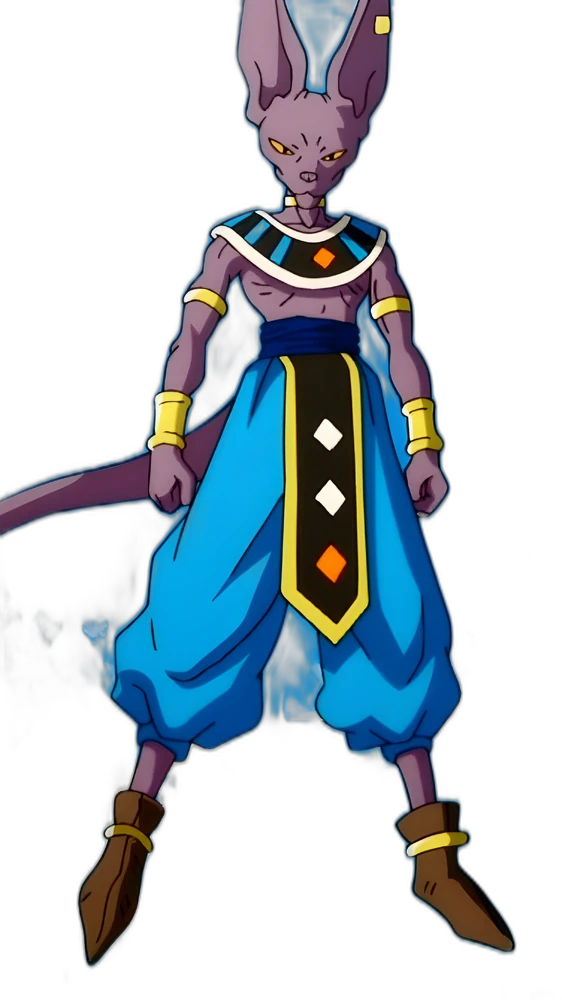
Gods of Destruction (Hakaishin) are supreme deities appointed to maintain universal balance through destruction. Each of the twelve universes in Dragon Ball Super has one God of Destruction, who serves alongside a Supreme Kai (god of creation) and is attended by an angel. The role of a God of Destruction is not purely malicious — they destroy planets, civilizations, and threats that have outlived their usefulness or threaten the cosmic order. This destruction is a necessary counterbalance to creation, preventing universes from becoming overcrowded or stagnant.
The Gods of Destruction were introduced in Dragon Ball Super with Beerus, the God of Destruction of Universe 7. Beerus awakened after a 39-year sleep when the Oracle Fish foretold the emergence of a being who could challenge him — the Super Saiyan God. His arrival fundamentally changed the power scale of Dragon Ball, introducing divine ki, god-level combat, and the multiversal hierarchy. Beerus's personality is a blend of absolute power and childlike whimsy, destroying planets over minor annoyances while also showing genuine appreciation for good food and entertainment.
There are twelve confirmed Gods of Destruction, though only a handful have been shown in detail. Beerus (Universe 7), Champa (Universe 6), Belmod (Universe 11), Quitela (Universe 4), and Giin (Universe 2) are among those who participated in the Tournament of Power. Each God of Destruction has a unique personality and fighting style, reflecting their universe's characteristics. The position is not necessarily limited to one species — Gods of Destruction can be mortals who have achieved divine power, as demonstrated by Toppo's candidacy in Universe 11.
Mechanics & Rules
The most critical rule governing Gods of Destruction is the life-link with their universe's Supreme Kai. If the Supreme Kai dies, the God of Destruction also dies. This connection was established by the Omni-King as a check on the Gods of Destruction's power — since their role is to destroy, they must also be tied to creation. Beerus nearly died when Shin was killed by Fused Zamasu in the Dragon Ball Super manga, confirming this link. This vulnerability means the God of Destruction must protect their Supreme Kai, even if they find them annoying or incompetent.
Gods of Destruction possess a unique energy type called Destroyer Ki (Hakai energy), which is distinct from regular ki and God ki. This energy allows them to perform Destruction — the ability to erase anything from existence completely, not just destroy it physically. Beerus demonstrated this ability by erasing Zamasu's body entirely, leaving nothing behind. The Hakai technique can be learned by mortals who train under a God of Destruction, as Vegeta demonstrated by learning the technique from Beerus. Destroyer energy is also channel-able through weapons and techniques, making it incredibly versatile in combat.
The Gods of Destruction operate under a divine hierarchy. They answer to the Omni-King (Zeno), who can erase them and their entire universe without effort. The Great Priest and the angels oversee their activities but do not command them directly. The Gods of Destruction cannot destroy angels, as angels are immune to all forms of destruction. Additionally, the Gods of Destruction are forbidden from destroying their own universe's Supreme Kai (because of the life-link) and must maintain the balance between creation and destruction rather than engaging in wanton annihilation.
Types & Classifications
The known Gods of Destruction vary significantly in personality and approach:
- Beerus (Universe 7): The most prominent God of Destruction. Beerus is a purple, cat-like deity awakened by the prophecy of the Super Saiyan God. He is capricious, sleeping for decades at a time, and prone to destroying planets over minor irritations. However, he has developed a genuine appreciation for Earth's cuisine and a grudging respect for Goku and Vegeta's growth.
- Champa (Universe 6): Beerus's twin brother, identical in appearance but with a lighter color scheme. Champa is more actively ambitious than Beerus, constantly seeking Dragon Balls and engaging in rivalry-fueled competition. His universe's God of Destruction counterpart rivalry led to the Universe 6 vs Universe 7 tournament.
- Belmod (Universe 11): A clown-like humanoid who leads the Pride Troopers' patron deities. Belmod is shown to be calculating and strategic, training Toppo as his successor. He participated in the Tournament of Power as a spectator and demonstrated genuine care for his universe's warriors.
- Quitela (Universe 4): A rat-like deity who defeated Beerus in an arm-wrestling contest, causing lasting animosity between them. Quitela is cunning and manipulative, attempting to use underhanded tactics during the Tournament of Power.
Notable Users & Examples
Key moments in Gods of Destruction history:
- Beerus Awakens: Beerus's awakening after 39 years of sleep kicked off the events of Dragon Ball Super. His search for the Super Saiyan God led him to Earth, where he demonstrated power that made previously fearsome villains like Frieza and Cell seem insignificant.
- The Tournament of Power: The Gods of Destruction participated in the Omni-King's multiversal tournament. Universe 7's team, organized by Beerus and Whis, won the tournament, with Android 17 making the wish to restore all erased universes.
- Toppo's God of Destruction Training: Toppo, a member of the Pride Troopers, trained under Belmod to become a God of Destruction candidate. During the Tournament of Power, Toppo accessed God of Destruction power, achieving a form that overwhelmed Super Saiyan Blue Vegeta.
- Beerus vs Goku: Beerus's battle against Super Saiyan God Goku was the first god-level fight in Dragon Ball. Their clashes shook the entire universe, demonstrating the catastrophic power of divine combat.
Strategic Analysis
Fighting a God of Destruction requires strategies fundamentally different from fighting mortal opponents. Destruction energy cannot be absorbed, blocked with conventional ki barriers, or regenerated from. A single Hakai attack can erase an opponent completely. The only known countermeasures are: dodging entirely, overwhelming the God of Destruction with speed, or using Ultra Instinct to automatically evade. Angels are completely immune to Destruction, and sufficiently powerful mortals like Jiren could resist Toppo's Hakai through sheer power.
Gods of Destruction vary significantly in combat approach. Beerus relies on overwhelming speed and destructive power, using techniques like Sphere of Destruction and Super Dragon Fist. Champa prefers aggressive, direct combat. Belmod is more tactical, using his clown-like appearance to deceive opponents. Against any God of Destruction, the optimal strategy is to avoid direct confrontation and exploit their personality flaws — Beerus's laziness, Champa's greed, Belmod's pride. However, if direct combat is unavoidable, fusion is the most reliable approach, as demonstrated by Vegito and Gogeta's effectiveness against divine opponents.
The life-link between Gods of Destruction and Supreme Kais creates a critical vulnerability. Targeting the Supreme Kai can neutralize the God of Destruction without engaging them directly. Zamasu exploited this by killing multiple Supreme Kais across timelines. However, this approach is extreme and risks creating imbalances that could destroy the entire universe. The most ethical strategy against a rogue God of Destruction is appealing to the Omni-King or the Great Priest, who have authority to remove them from their position.
FAQ
What is a God of Destruction?
A God of Destruction (Hakaishin) is a deity appointed to destroy planets, civilizations, and threats to maintain universal balance. Each of the 12 universes has one.
How many Gods of Destruction exist?
There are 12 Gods of Destruction, one per universe. Notable ones include Beerus (Universe 7), Champa (Universe 6), Belmod (Universe 11), and Quitela (Universe 4).
What is the life-link between a God of Destruction and Supreme Kai?
If the Supreme Kai dies, their universe's God of Destruction also dies. This connection ensures that destroyers remain connected to creation, maintaining cosmic balance.
Can a God of Destruction be defeated?
Yes, by beings of equal or greater power, including angels, other Gods of Destruction, and mortals who achieve divine techniques like Ultra Instinct or Ultra Ego.
How does someone become a God of Destruction?
A candidate is typically chosen by the current Destroyer or appointed by higher divine beings. Toppo from Universe 11 trained as a candidate under Belmod.