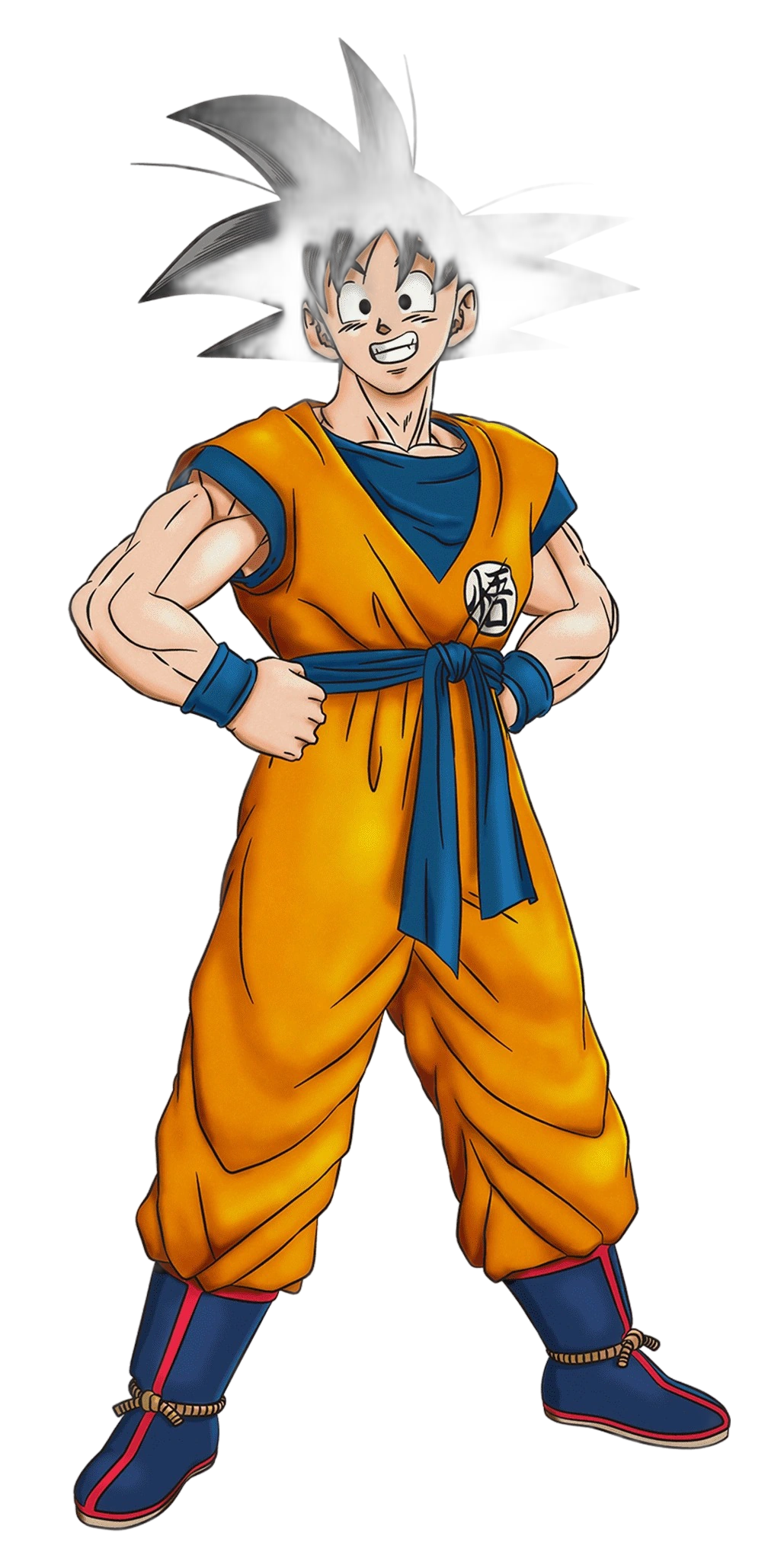
1. Overview
Son Goku, born Kakarot on Planet Vegeta, is the main protagonist of the Dragon Ball series and the most recognized anime hero worldwide. Sent to Earth as a infant Saiyan warrior, a childhood head injury erased his destructive programming and left him with a pure heart, boundless curiosity, and an insatiable love for martial arts. From his first training under Master Roshi to mastering Ultra Instinct under Whis, Goku's entire existence has been defined by continuous self-improvement and the thrill of fighting stronger opponents.
This guide provides a complete resource for understanding Goku's abilities, training path, combat strategies, and matchup dynamics. Content reflects the Dragon Ball Super manga up to the Granolah and Super Hero arcs. Whether you are analyzing his power scaling for discussions or building him in Dragon Ball video games, this page offers the full picture.
2. Basic Data
| Attribute | Son Goku | Saiyan Average | Notes |
|---|---|---|---|
| Species | Saiyan (Low-Class) | Saiyan | Born low-class, achieved what no elite Saiyan could |
| Height | 175 cm (5'9") | ~180 cm | Slightly shorter than Vegeta |
| Weight | 62 kg (137 lbs) | ~75 kg | Lean, athletic build |
| Base Power Level | 10,000 (Saiyan Saga) | 1,200-4,000 | Increased 50x via Kaioken |
| Peak Form | Ultra Instinct (Mastered) | N/A | Body moves independent of thought |
| First Appearance | Dragon Ball Ch. 1 (1984) | N/A | Debuted as a child with tail |
3. Ability Analysis
Kamehameha. Goku's signature energy wave, learned from Master Roshi. The Kamehameha charges in the user's cupped hands and fires a concentrated beam of ki. Goku has developed dozens of variants: the Super Kamehameha (charged for maximum output), the Instant Kamehameha (combined with Instant Transmission for an unavoidable surprise attack), and the Father-Son Kamehameha (performed with Gohan's spirit energy during the Cell Games). The key differentiator is Goku's ability to fire it from any body position, including his feet, and to adjust its size from a narrow piercing beam to a wide sweeping blast. Common mistake: holding the charge too long in competitive matches leaves Goku vulnerable to interruption. Fire as soon as the charge reaches 80% if the opponent is closing distance.
Spirit Bomb. Goku's ultimate technique, gathering energy from all living things including plants, animals, and other planets. The Spirit Bomb requires absolute stillness to concentrate, making it nearly impossible to deploy in active combat without protection. Against Kid Buu, Goku needed Super Saiyan-level speed just to survive long enough to complete the charge. Key strength: the Spirit Bomb bypasses conventional durability because it attacks on a spiritual level. Key weakness: it cannot be used against evil individuals who have reformed (Vegeta during the Buu Saga was immune because his heart had changed). Best used as a finishing move with a teammate buying time.
Instant Transmission. The Yardratian technique that allows Goku to teleport to any location by locking onto a ki signature. The cooldown is roughly 1-2 seconds between jumps, and Goku cannot teleport into an area he cannot sense. This limitation means energy-nullifying fields or opponents who suppress their ki completely (like Hit's time-skip dimension) can counter it. Practical applications include flash Kamehameha setups, dodging unavoidable attacks, and transporting large objects (like Cell's self-destruct). Also useful for quickly moving allies out of danger, as shown when he evacuated everyone from Namek's explosion.
Kaioken. A multiplying technique taught by King Kai that pushes the user's power beyond natural limits. The standard Kaioken doubles power at the cost of proportional body strain. Goku's mastery allows up to Kaioken x20, and he has combined it with Super Saiyan Blue (SSBKK) for a 10x boost beyond Blue's base power. Critical limitation: Kaioken burns stamina at an accelerating rate. Past 30 seconds of SSBKK, the damage to Goku's body becomes severe. The technique is best saved for short bursts to surprise an opponent or counter a temporary power spike.
4. Build / Training Recommendations
Build 1: Balanced Progression (Beginners). Focus on base form mastery before pursuing transformations. Train with 100x gravity (standard in Dragon Ball games) to build strength in base, then unlock Super Saiyan as a 50x multiplier. Recommended skill order: Kaioken (early burst option) -> Super Saiyan (staple form) -> Super Saiyan 2 (2x SSJ) -> Super Saiyan 3 (4x SSJ, but drains stamina). This build is ideal for story-mode progression and learning the fundamentals of ki management.
Build 2: God Ki Optimization (Advanced). Skip SSJ2 and SSJ3 entirely after unlocking Super Saiyan God. SSG provides 15x SSJ multiplier with near-zero stamina drain, making it superior for sustained fights. Stack Super Saiyan Blue on top for raw damage output. Unlock SSBKK for 10-second burst windows. The end goal is Ultra Instinct: Sign (autonomous dodge) and Mastered Ultra Instinct (autonomous attack). MUI gives Goku a massive speed advantage that compensates for his lower raw power compared to Vegeta's Ultra Ego.
Build 3: Tournament Survivor (Specialized). For arena-style battles where stamina management matters most. Stay in base form for the first 30% of the match to bait opponents, then skip directly to Super Saiyan Blue when they commit. Save Ultra Instinct for the final 20% of the fight. SSBKK is not recommended in this build as its stamina cost leaves Goku exhausted. Instead, rely on Instant Transmission to control positioning and the Spirit Bomb as a ring-out tool.
Common Training Mistakes. Relying too heavily on higher forms instead of mastering base combat. Many players neglect base form training and end up unable to fight effectively when transformations expire. Always maintain at least 30% ki reserve for Emergency Instant Transmission.
5. Strategy Guide
Early Game (0-3 minutes). Assess the opponent's speed and combat rhythm. Stay in base or SSJ form to conserve energy. Use Instant Transmission to reposition and throw off the opponent's timing. Land 2-3 Kaioken-enhanced strikes to gauge their defensive reactions. Do not commit to heavy ki blasts yet; observe how they handle projectile spam.
Mid Game (3-8 minutes). Escalate to Super Saiyan Blue once you understand the opponent's patterns. SSB's godly ki pressure forces most opponents to use their own high-end transformations early, draining their stamina. Mix up your approach: use Instant Kamehameha for surprise damage, then follow with a close-combat string. If the opponent adapts to teleport patterns, switch to raw speed attacks instead. This is the ideal window for a Spirit Bomb if you have a teammate providing cover.
Late Game (8+ minutes). Activate Ultra Instinct when both stamina bars are low and the opponent cannot maintain their peak form. MUI's auto-dodge creates frustration for opponents relying on predictable combos. Land decisive blows during the opponent's recovery frames. Avoid using high-cost techniques like SSBKK or full-power Kamehameha unless you are certain they will connect. One missed attack at this stage often loses the match.
6. Matchup Analysis
Goku vs. Vegeta. Evenly matched with different strengths. Goku wins in speed and technique variety (Ultra Instinct vs. Vegeta's Ultra Ego). Vegeta wins in durability and endurance. Key advantage for Goku: Vegeta's Ultra Ego relies on taking damage to grow stronger, but Goku's MUI avoids hits entirely, starving Vegeta's power ramp. Counter: Vegeta players should switch to SSB Evolution early to force Goku into a damage trade rather than a dodge contest.
Goku vs. Frieza. Goku has the edge in transformations and stamina, while Frieza has higher base stats and more combat experience. Goku's strategy should focus on dragging the fight to later stages where Frieza's Golden form stamina drain becomes a problem. Key danger: Black Frieza can one-shot both MUI Goku and UE Vegeta simultaneously as shown in the Granolah arc. If facing Black Frieza, avoid direct confrontation and use Instant Transmission to buy time for a Spirit Bomb.
Goku vs. Jiren. Jiren outstats Goku in every category except technique. Goku must rely on Ultra Instinct's auto-dodge to avoid Jiren's power-based attacks. The winning strategy is to force Jiren into expending energy on wide-area attacks while Goku dodges narrowly, then counter during the 1-second recovery. Never try to block Jiren's full-power strikes. The Father-Son Kamehameha is the most effective finisher against him.
7. Expert Tips
Hidden Mechanism: Zenkai Boost Timing. Goku's Saiyan biology provides a significant power increase after near-death recovery. In games that simulate Zenkai, the optimal strategy is to fight at 10-20% HP to trigger the boost, then heal before the opponent lands the finishing blow. The boost is permanent for that session, so triggering it early maximizes the benefit across the entire fight.
Animation Cancel: Instant Transmission Recovery. Goku can cancel the recovery animation of his Kamehameha by using Instant Transmission immediately after firing. This removes the 1-second vulnerability window that normally follows a beam attack. Master this cancel to chain Kamehameha into close-range melee combos.
Top 3 Beginner Mistakes. (1) Overusing Super Saiyan 3 in long matches. SSJ3 drains stamina 4x faster than SSJ2 and offers diminishing returns. Most opponents will outlast you. Stay in SSJ or SSG for sustained fighting. (2) Firing the Spirit Bomb in neutral combat without setup. The charge time leaves Goku completely exposed. Only use it with a teammate screen or when the opponent is knocked down. (3) Neglecting base form combat skills. When transformations expire or are nullified, weak base fundamentals will lose matches. Practice base form sparring 30% of your training time.
8. FAQ
Q: What is Goku's strongest form?
Mastered Ultra Instinct (MUI) is currently Goku's most powerful transformation. It allows his body to react and attack autonomously, without conscious thought. However, Black Frieza has demonstrated power surpassing both MUI Goku and Ultra Ego Vegeta, suggesting more evolutions are ahead.
Q: How does Goku's power compare to Vegeta?
Goku and Vegeta are essentially equals, with different specializations. Goku's Ultra Instinct prioritizes speed and evasion, while Vegeta's Ultra Ego focuses on durability and damage absorption. In direct combat, the matchup is close to 50-50, depending on the situation and emotional state of each fighter.
Q: Why does Goku not use the Spirit Bomb more often?
The Spirit Bomb requires gathering energy from living things, which takes considerable time and complete concentration. Goku is vulnerable during the charging phase and cannot move. It is a situational finisher, not a spammable technique, best used with allies providing cover.
Q: Can Goku still grow stronger?
Yes. Goku's entire character arc is built on limitless potential. In the Granolah arc, he acknowledged that Beerus is still far beyond his level, and he continues training with Whis to refine Ultra Instinct. His Saiyan biology and relentless drive mean his ceiling is constantly rising.
Q: Is Goku a good fighter or just naturally talented?
Both. Goku has immense natural talent and Saiyan potential, but he also works harder than almost anyone in the series. He trains daily under extreme conditions, invents new techniques, and learns from every opponent. His growth comes from a combination of innate ability and unprecedented work ethic.